The Darkmoon Odyssey · Book One · Coming on the 4th of November 2026
The Darkmoon Dogs
We were idiots, and we were together, and in a universe that wants you alone and quiet, that is the only sum that matters.
I was nineteen, and I could put a price on anything. Then eleven idiots followed me.

The book
Somewhere in that column was the price of me.
I was nineteen, and I could put a price on anything. A man’s harness. A friend’s usefulness. What it would cost me to walk out of the Academy alone, which was the only way I ever planned to walk out of anywhere.
Then eleven idiots followed me.
We stole an Academy transport and nine artefacts nobody could name, and ran for the border to be privateers, which is the word people use when they would rather not say what they actually did. The second ship we took had twenty-three children in her hold, and a manifest with a column that should not have existed.
We named her badly. I lost that vote ten to one.
The Darkmoon Dogs is Book One of The Darkmoon Odyssey.
The facts
- Series
- The Darkmoon Odyssey
- Volume
- Book One
- Genre
- Space opera
- Format
- Kindle eBook
- Length
- About 112,000 words
- Release
- 4th of November 2026
Pre-order on Amazon
The Dogs
Arjak Tomi
Counts everything, including the things nobody wants counted. Tells this one himself.
Friss Marlo
Said the quiet part out loud in a doctrine lecture, then folded up like a chair.
Zaro Mattie
Flies her. Knows exactly what the ship will do, and precisely what it costs to ask.
Julee Santos
Compact and still, one of those people who look relaxed right up until they aren’t.
Hallix Hansam
Built like a loading crane. Nobody ever asked what he did before the Academy got him.
Davik Raffi
Runs on spite, according to Adam. Says nothing, which is normal.
Torven Aske
A scar that pulls his mouth into half a smile. Doesn’t steal; fills out the form correctly.
Dynaeti Humbo
Plots the course, and marks in the margin exactly where you were going to get caught.
Markin Sato
Knowing things is his entire business model. Everyone is a line on his balance sheet.
Seris Clapius
Calls everyone by surname and rank until she decides otherwise. That can take a year.
Adam Greens
Scores solidly nothing. People go towards him anyway, the way water finds the low part of a deck.
Jakio Sen
Feeds you twice, because you’ll eat the first one standing up. Keeps the medical locker.
Read the opening
Chapter OneCalibration Arena
Three hundred paces to the Calibration Arena, and I counted every one of them, because counting was better than dreading the arrival.
The walls down that stretch were a green they must have chosen purely by price. The colour of something barely kept alive. A cadet came past me going the other way with his shield harness still on, straps cutting red grooves into his shoulders, holding his ribs the way you hold something broken. He favoured his left and somebody had noticed that he favoured his left. That somebody had gone at that side until it stopped being a habit and started being an injury.
I catalogued it without meaning to. Right-handed opponent, exploiting a weak rotation. The Academy trained everybody the same way, so most of us fought with the same three mistakes, and if you paid attention you could take people apart with a list.
That sounds arrogant. It isn’t, I’ve tested it.
I smelled the arena from thirty paces out. Sweat, and that sharp electrical bite off the shield generators, and under it something coppery. Fear sweat runs different from the working kind, higher in copper, and it comes through the skin carrying the stress hormones out with it. You end up knowing that sort of thing if you spend enough years fighting over ration chits in the darker places, learning what a desperate man smells like just before he swings.
The octagon was black matte tile that gripped your boots and made everything look expensive for the cameras. Above it, the observation gallery, a long band of glass with shapes moving behind it. Instructors and sponsors, deciding which of us was worth buying and which of us was worth burying, with a form for both.
There was a wall panel at waist height on the far side, three metres in from the perimeter line, and I stopped walking when I saw what had happened to it.
Duels shouldn’t do that to a wall. A duel is two men leaning on each other and cooking, and the worst a wall gets out of it is scuffed. That panel was scorched in a fan and pushed in about two centimetres, and something has to arrive very fast indeed to leave a shape like that.
A Mirror does one thing. Push a blade into the field and the field takes hold of it, and everything you put into that swing comes back at you as heat in your own kit. That is a duel. Two men heating each other up and waiting to see whose harness gives in first. But go fast enough and the field stops taking hold and starts throwing, and it throws the thing back out along whatever angle it came in on. Forty metres a second is the line. Everybody knows the number. Nobody thinks about it, because nothing in a duel goes that fast. A blade tip at full swing is thirty. And nothing the field does is free. Whatever it throws back, the mount pays for as heat, so a man who gets hit often enough is cooked by his own shield whether anything gets through it or not.
I looked at the buckled plastisteel for ten seconds and then I went and stood on my mark.
Caius Vane was already inside, running his thumb along the seam of his harness.
You could tell what a man’s family was worth from his harness, if you knew where to look. Mine was standard issue, which meant one broad strap over the collarbone and a prayer. When a Mirror turned a hit, all that force had to go somewhere, and standard issue put it through the clavicle. Caius wore a Vane Industries rig with eleven mounting points, and it spread a strike across his whole back like a hand pressing rather than a fist punching.
The shield doesn’t save you. It just decides where you take the hit.
Audiobook
The audiobook
The whole book, read aloud, free on Spotify: one chapter per episode.
6 of 18 chapters out now
From the book
6 platesThe plates
Six plates are drawn into the book: Arjak's own sketches, made from memory twenty-two years after, and not to be navigated by. Three of them are safe to look at before you read. The other three give things away.
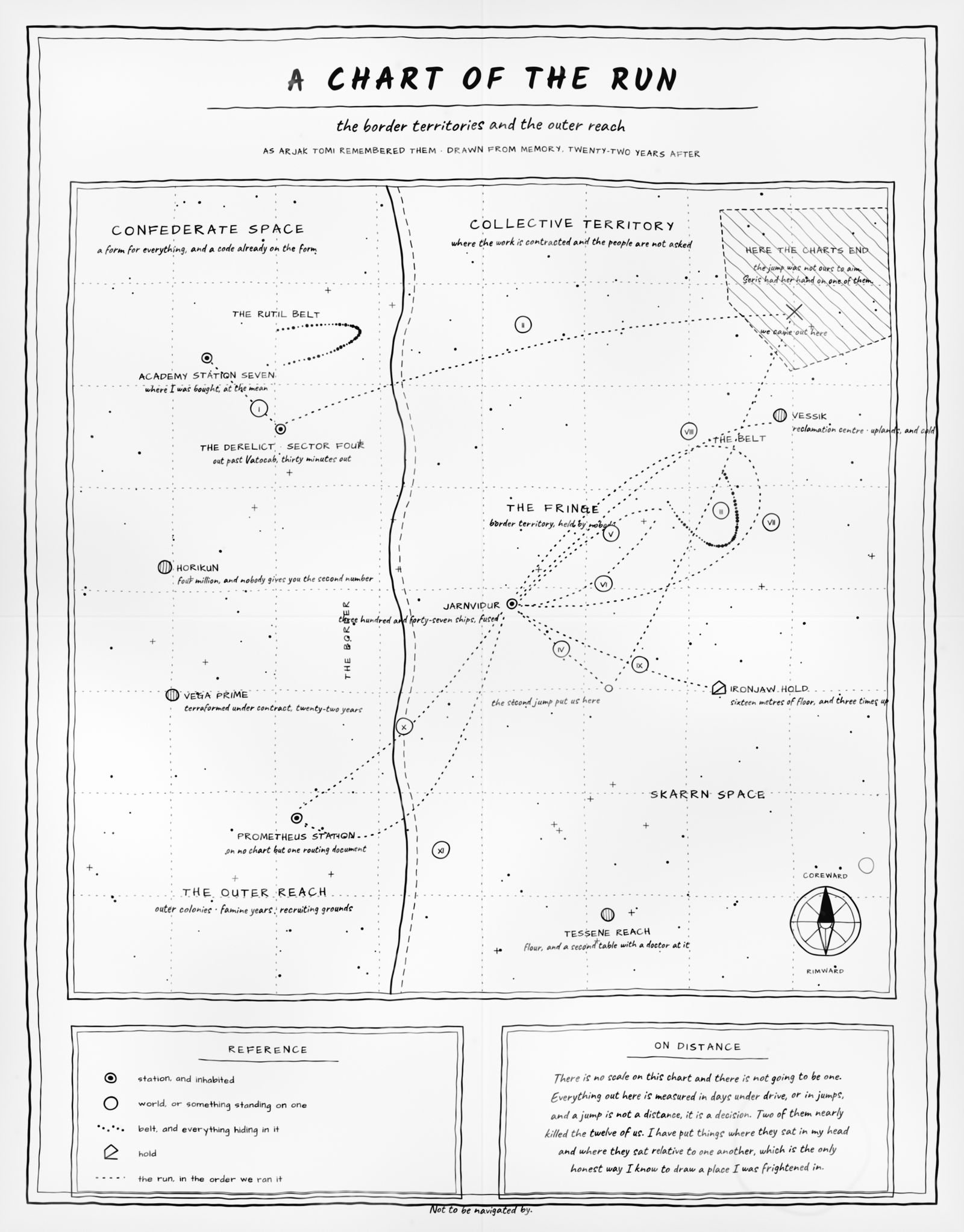
A Chart of the Run
The border territories and the outer reach. A jump is not a distance, it is a decision.
Full size →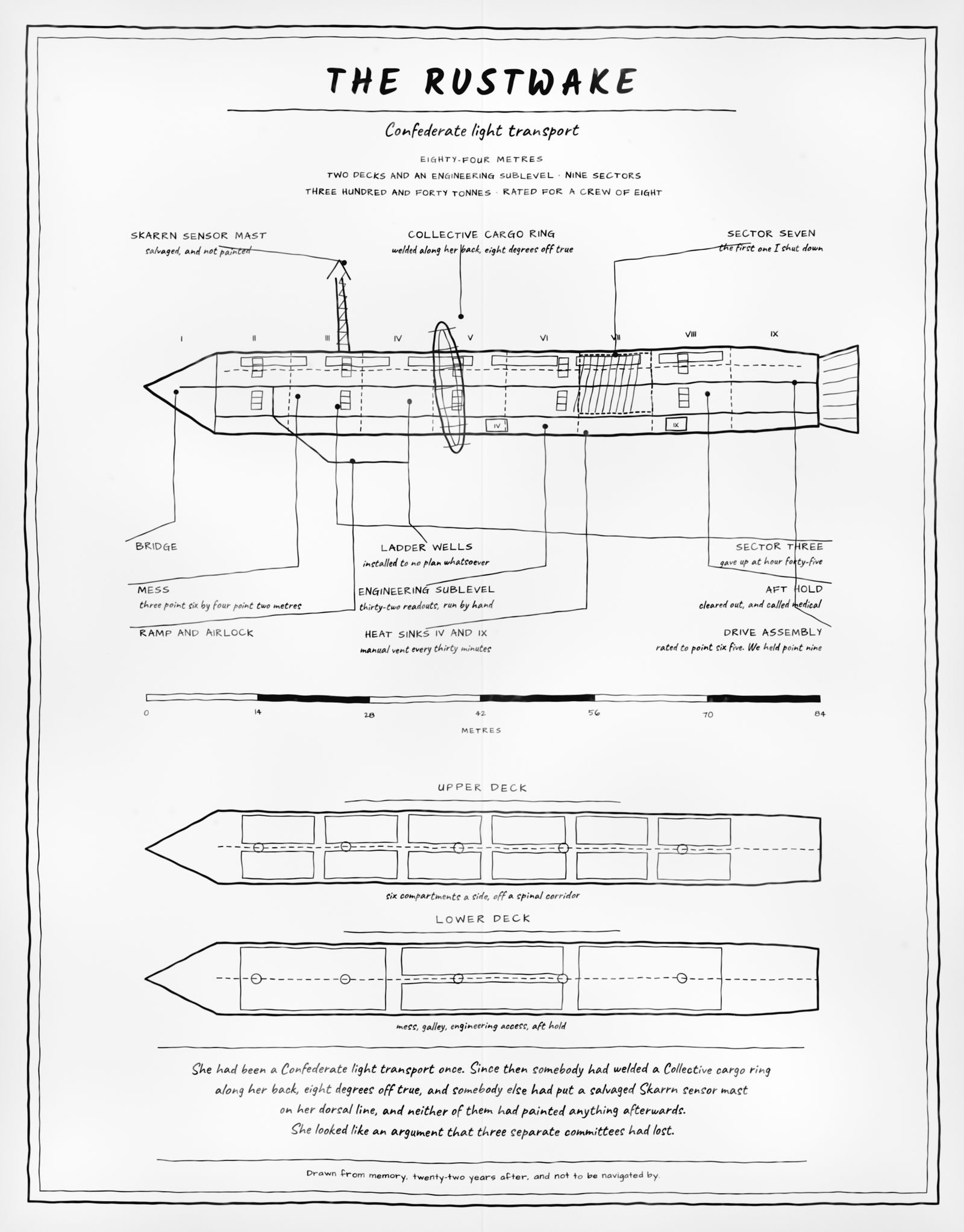
The Rustwake
She looked like an argument that three separate committees had lost.
Full size →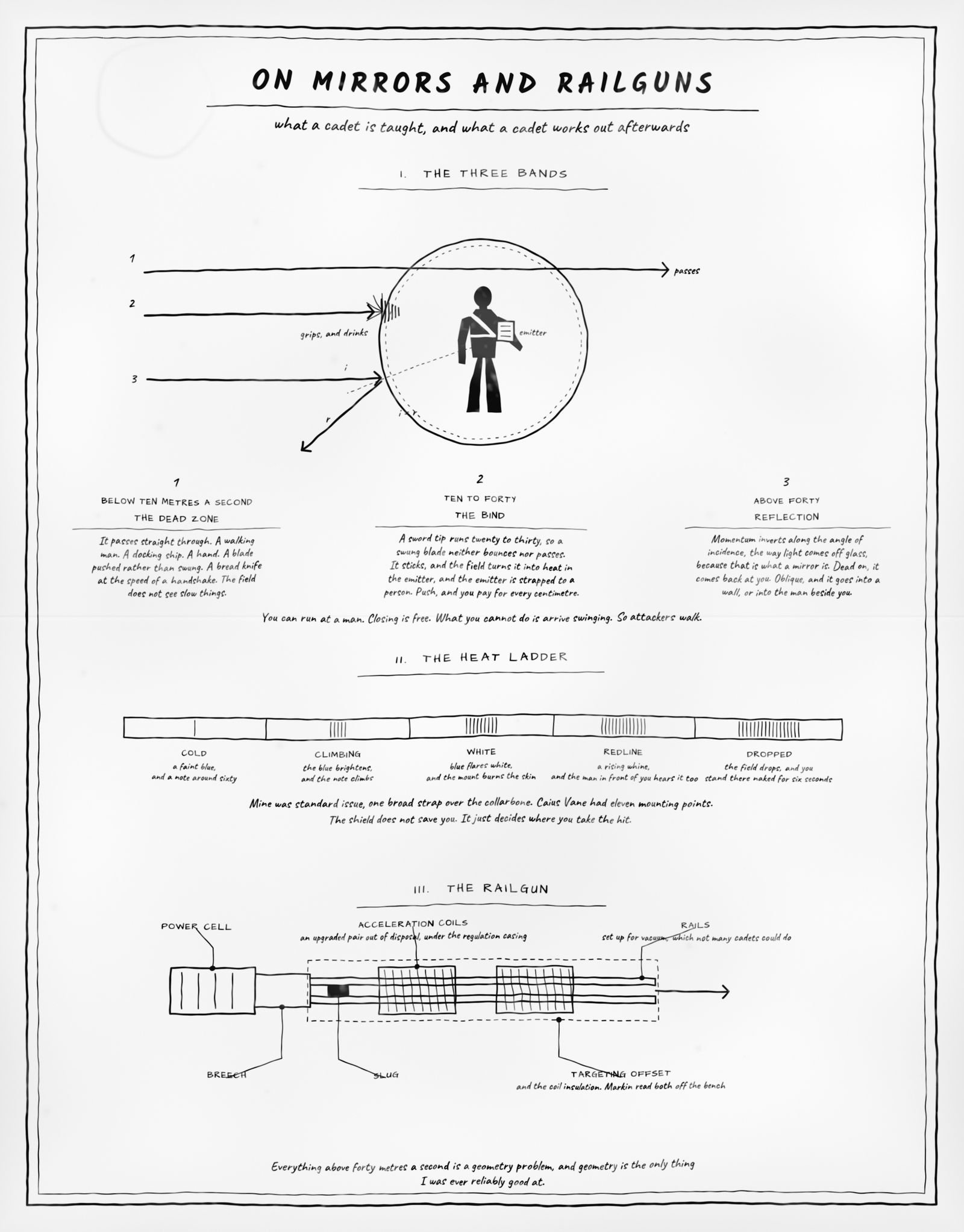
On Mirrors and Railguns
What a cadet is taught, and what a cadet works out afterwards.
Full size →Show 3 more platesHide the spoiler plates contain spoilers
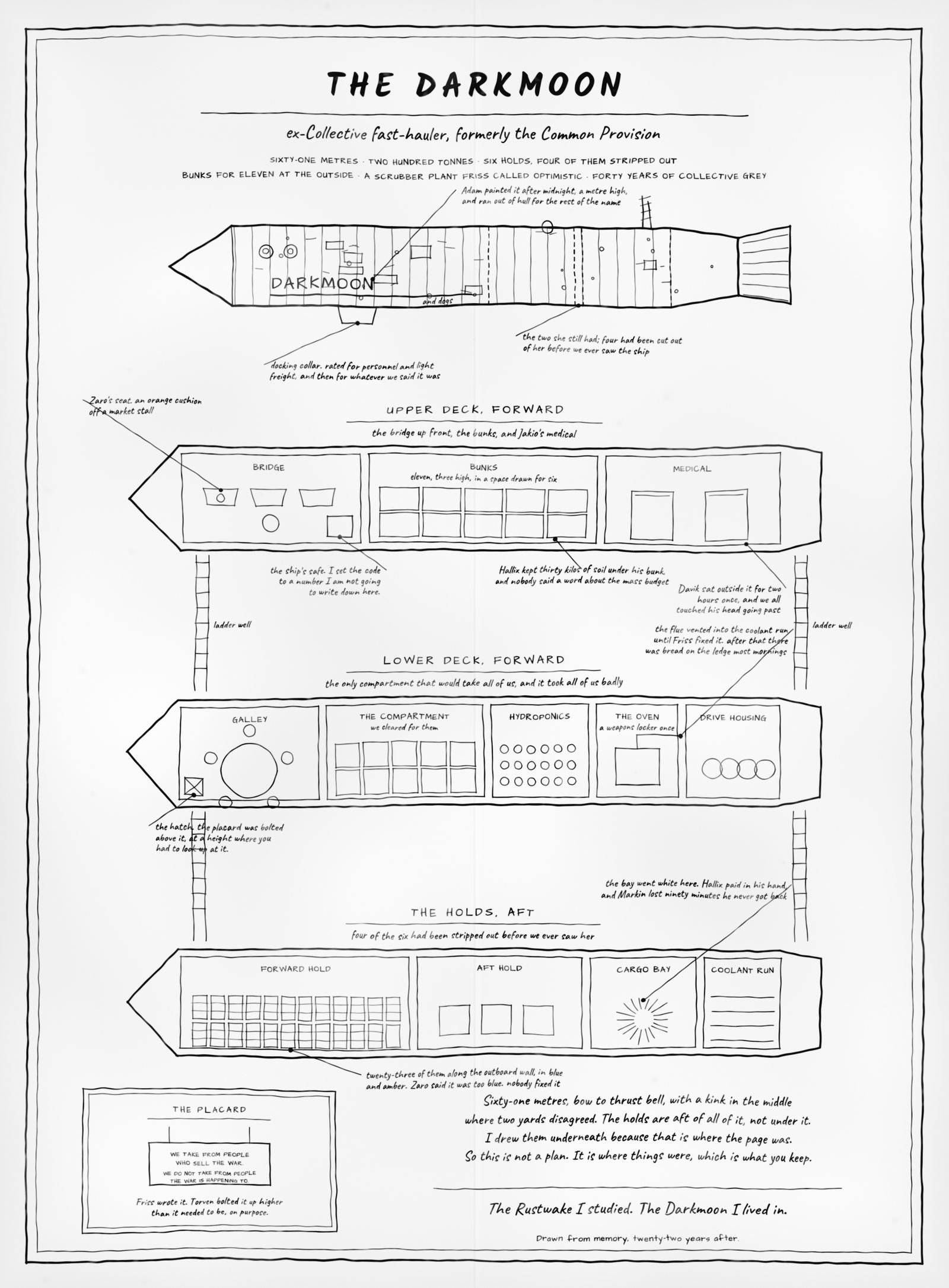
The Darkmoon
The Rustwake I studied. The Darkmoon I lived in.
Full size →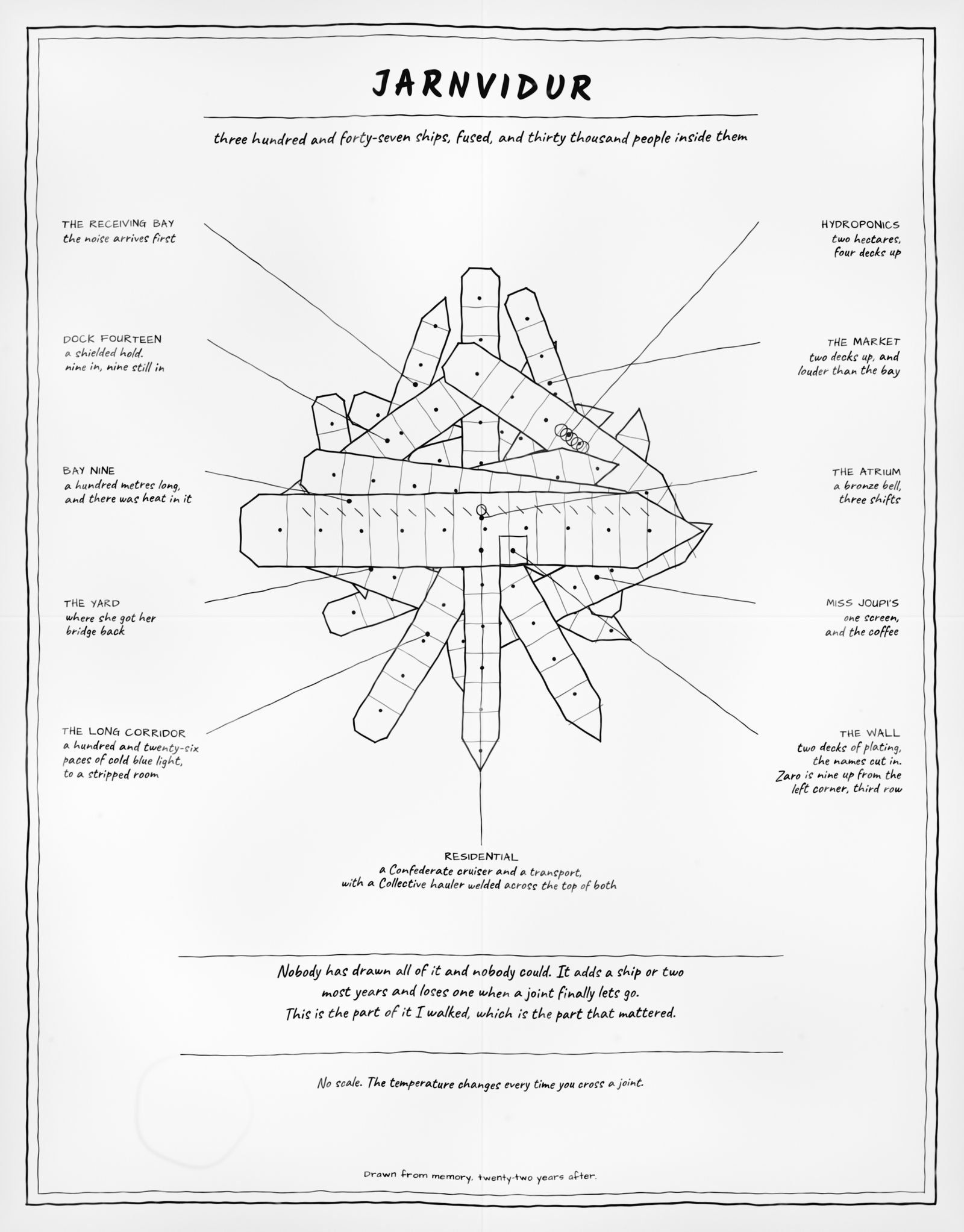
Jarnvidur
Three hundred and forty-seven ships, fused, and thirty thousand people inside them.
Full size →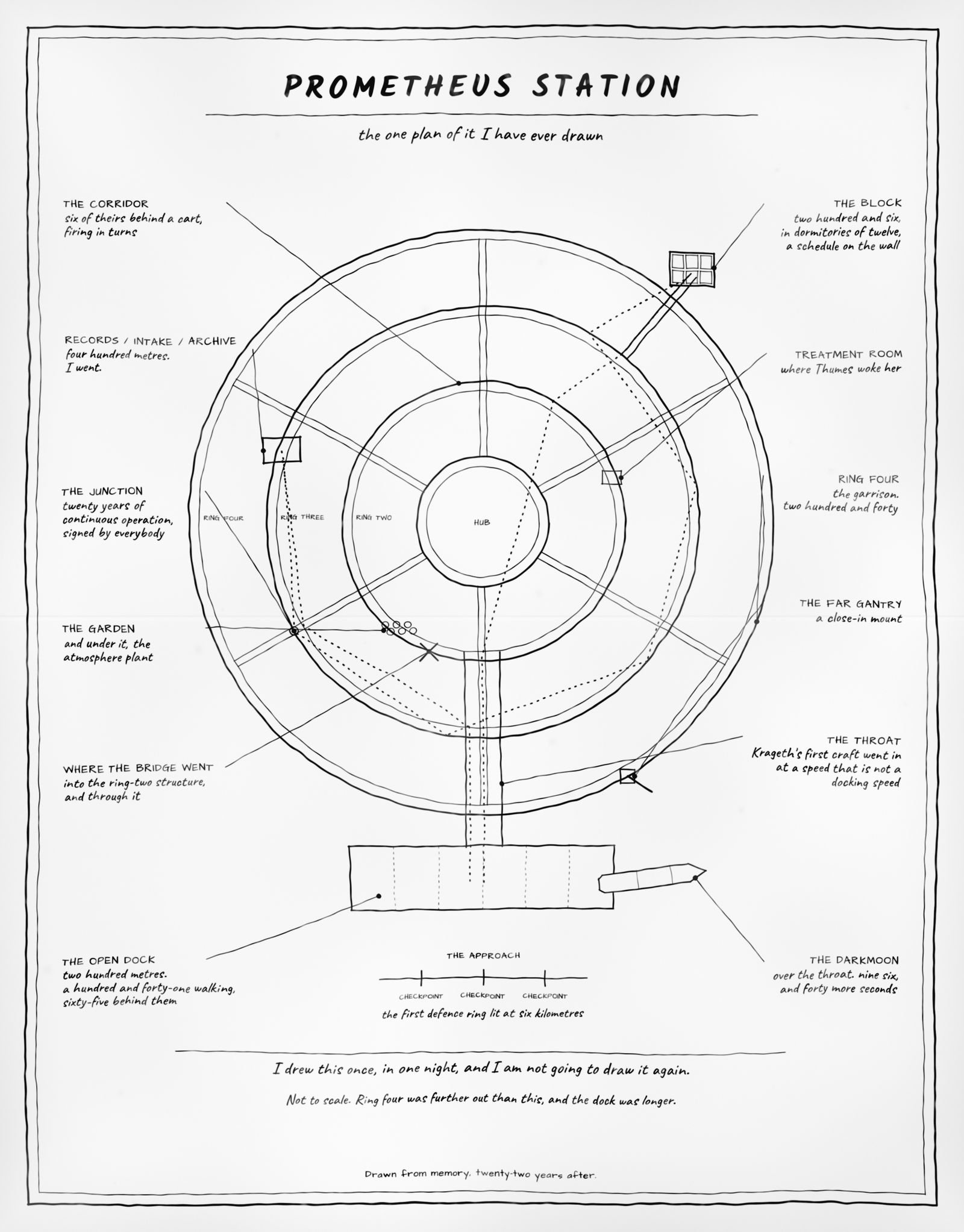
Prometheus Station
I drew this once, in one night, and I am not going to draw it again.
Full size →The Darkmoon Odyssey
A crew of runaway cadets, a stolen ship, and the border territories, told years later by the one who counted everything.
The series →- Book OneThe Darkmoon DogsComing on the 4th of November 2026
- More books in the series are on the way.
